You've just left the veterinary clinic with a vaccination certificate, a blood-test PDF, or a prescription photo. You forward it to a family WhatsApp group, your pet sitter, or another vet, usually without a second thought. The record concerns your dog or cat, but it may also carry your name, phone number, address, payment details, and the clinic's identifiable contact information.
That is where India's Digital Personal Data Protection Act, 2023, commonly called the DPDP Act, becomes relevant. It doesn't treat every fact about an animal as personal data. It does, however, regulate digital personal data connected to identifiable people, and pet records often contain more information about people than owners realise.
The WhatsApp Forward That Quietly Counts as Personal Data
Your dog needs a boarding stay, so you open WhatsApp and forward a vaccination certificate to the caretaker. The PDF shows the dog's name, vaccination date, and vaccine type. It also shows your name, mobile number, home address, the veterinarian's name, and the clinic's phone number.
The dog's vaccination date, standing alone, is information about an animal. It isn't personal data merely because it appears in a digital file. But the owner's name and phone number identify a person. The address may identify where that person lives. The vet's name and clinic details may identify another person or organisation. One ordinary attachment has become a package of information about several humans.
Practical rule: Treat a pet record as a mixed file. Separate the animal-health facts from the human-identifying details before deciding how it should be stored or shared.
The same issue appears when a clinic emails a lab report, a shelter sends an adoption file, or a pet parent uploads a photograph of a prescription. A record may also include a WhatsApp number for a household member, a forwarding address, or the name of a volunteer responsible for the animal. Those people may become Data Principals, meaning individuals whose personal data is being handled.
The DPDP Act was enacted by Parliament on 11 August 2023 as Act No. 22 of 2023, and it establishes a framework for processing digital personal data while balancing privacy with lawful use.
For pet owners, the important question isn't “Is my pet's medical history private?†in the abstract. It's “Which people are represented in this record, who decides how it is used, and who can open it after I share it?â€
Data Principal, Data Fiduciary, and the People Inside the Record
Think of a veterinary clinic. The person whose phone number appears on an intake form is the person described by the information. Under the DPDP Act, that person is the Data Principal. The clinic or service deciding why the information is collected and how it will be used is the Data Fiduciary.
In plain English:
- Data Principal: The individual whose personal data is processed. A pet owner is the Principal for their own name, address, and contact details. A household member or volunteer can be a Principal for their details too.
- Data Fiduciary: The organisation or person deciding the purpose and means of processing. A record platform may be the Fiduciary for storage, reminders, account management, and sharing features.
- Data Processor: A helper that processes data for the Fiduciary. Cloud storage, OCR, email-ingestion, messaging, analytics, and backup vendors may fit this role when they follow the Fiduciary's instructions.
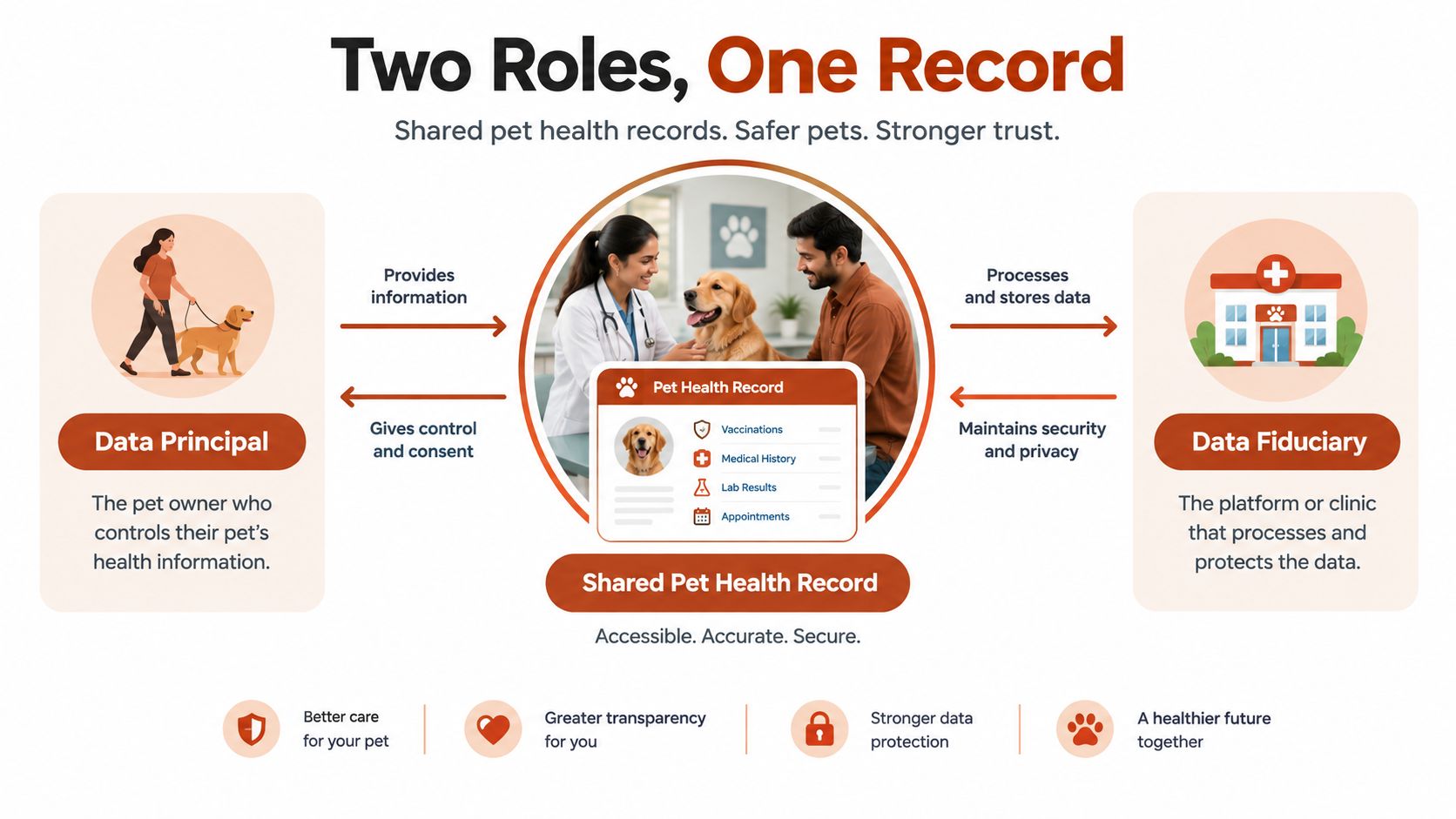
The labels can change as the same record moves. A vet clinic may decide why it uses an owner's details for clinical administration. A pet-record service may separately decide why it stores uploaded files and enables owner-controlled sharing. A cloud provider may process the files on the service's instructions.
The Act defines a Data Fiduciary as the entity determining the purpose and means of processing personal data. The DPDP Act also addresses guardian consent for children and people with disabilities who have lawful guardians, as well as additional obligations that may apply to Significant Data Fiduciaries.
Use this quick test for any pet-record service:
- Whose identifiable information appears in the record? List owners, household members, vets, sitters, volunteers, and adopters.
- Who decides why the service collects and shares it? That party is likely determining the purpose.
- Which vendors handle it behind the scenes? Those vendors may be processors and need contractual safeguards.
- Can each person understand, access, correct, or delete their information? If the answer isn't clear, the workflow needs attention.
A helpful example is how shelters can track vaccinations without losing records. The animal's health history may be central, but the system still handles information about adopters, volunteers, staff, and clinics.
What Counts as Valid Consent for Pet Record Workflows
A consent screen can look friendly and still ask for too much. Suppose an app presents one checkbox saying, “I agree to the terms, storage, vet sharing, reminders, marketing, payment processing, and all future uses.†That design makes it difficult to tell what the user accepted.
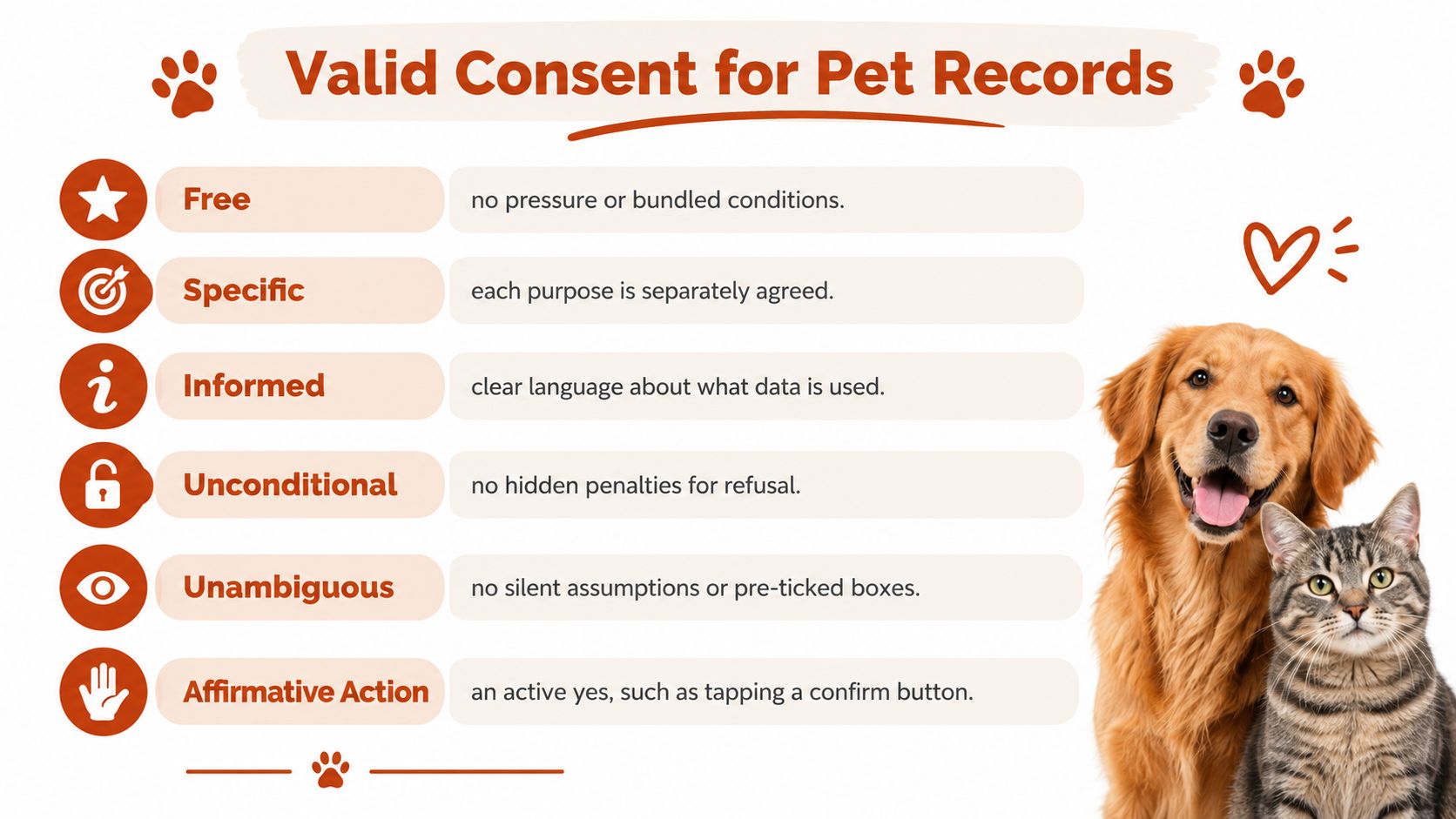
The DPDP Act expects consent to be free, specific, informed, unconditional, unambiguous, and based on clear affirmative action. Each word has a practical meaning for pet records.
- Free: A pet parent shouldn't be forced to agree to optional sharing just to create an account for basic storage.
- Specific: Storage, automated filing, reminders, and link-based sharing should be explained as distinct purposes where they serve different functions.
- Informed: The notice should say what information is collected, such as owner contact details, uploaded PDFs, images, and sharing metadata.
- Unconditional: Refusing optional access for a sitter shouldn't block unrelated account functions.
- Unambiguous: A pre-ticked box or silence isn't a clear yes.
- Affirmative action: Tapping a confirmation button after reading a plain-language notice provides a clearer record of choice.
A sensible platform keeps a consent ledger. It records the notice version, purpose, timestamp, user identity, scope of consent, and whether the user later withdrew it. This isn't just paperwork. It helps answer a simple question: what did this person agree to, and when?
Withdrawal should be as easy as granting consent. If an owner turns off a sharing purpose, the platform should stop the relevant processing, tell processors to stop where appropriate, and deal with the associated record according to the law. The Ministry of Electronics and Information Technology's DPDP materials explain the connection between consent, purpose limitation, processors, withdrawal, and erasure.
Deletion also needs context. If consent is withdrawn or the stated purpose is no longer served, personal data should be erased unless another law requires retention. A shared link shouldn't become an indefinite public doorway because it was once sent to a vet or sitter.
Reasonable Security Safeguards Translated Into Real Engineering
Consent answers whether a service may process personal data. Security answers whether it can do so safely. Section 8 of the DPDP Act requires reasonable security safeguards, including for processing performed by Data Processors, and requires the Data Fiduciary to intimate the Board and affected Data Principals of a personal data breach.
For a pet-record service, the legal phrase becomes a practical build list:
- Encrypt files in transit and at rest. Uploaded PDFs and images should be protected while moving between devices and servers, and while stored.
- Isolate records by tenant and authorisation policy. One household, clinic, shelter, or pet should not gain access merely because someone knows another record's identifier.
- Use short-lived, revocable share tokens. A link for a boarding provider should expire or be revoked rather than remain permanently usable.
- Protect forwarding addresses from enumeration. Someone shouldn't be able to guess addresses and discover uploaded documents.
- Test backups and recovery. A backup that has never been restored is an assumption, not a recovery plan.
The DPDP Rules, 2025 spell out the minimum safeguards: encryption, obfuscation or masking, access controls, logging and monitoring, backups for continuity, retention of relevant logs, and contractual safeguards with processors. A platform choosing a pet-health app should ask how these controls apply to uploads, downloads, shared links, deletion, and administrative access. For practical questions about selecting a service, see how to choose a pet health app.
Logging deserves its own attention. A useful audit trail records uploads, downloads, sharing, revocation, deletion, and administrator activity. When something goes wrong, those records help identify which files were affected, who accessed them, which links must be cancelled, and which Data Principals may need notification.
A breach runbook should cover containment, credential rotation, link revocation, processor coordination, forensic preservation, and communication in plain language. The Rules require affected individuals to be told promptly, in plain language, and a detailed report to go to the Board within 72 hours of becoming aware of the breach, unless the Board allows a longer period.
Nightly backups alone won't answer those questions. Teams need tested restoration, documented recovery objectives, processor notification clauses, and a way to identify every person whose account or shared record may have been exposed.
Why Pet Data Is Not Personal Data Is Half Right
The sentence “pet data isn't personal data†is only partly correct. A diagnosis about a dog or a vaccination date for a cat doesn't identify a natural person by itself. The surrounding fields may do so immediately.
Separate the record into three layers:
- Animal-health facts: A species, diagnosis, vaccination, allergy, or lab result concerning the animal.
- Owner-identifying metadata: A name, mobile number, address, email, payment detail, WhatsApp number, or account identifier.
- Professional and caregiver identifiers: A vet's name, clinic contact details, sitter's phone number, shelter volunteer information, or adopter details.
The first layer may sit outside the Act when it doesn't identify a person. The second and third layers can bring the workflow inside it.
This also affects shared access. A household member who manages appointments, a sitter who receives a temporary link, or a rescue volunteer listed in an adoption file may have personal data in the system. They aren't invisible because the record's subject is an animal.
A good privacy notice should therefore avoid the vague phrase “we process pet data†as if that explains everything. It should identify the owner information, contact details, uploaded documents, sharing recipients, and purposes separately. That approach usually makes the notice shorter and clearer, because it distinguishes animal information from the human details that trigger the DPDP Act.
When Do These Duties Start?
Not all of it applies today. The government notified the DPDP Rules, 2025 on 13 November 2025 and phased in the rules over 18 months:
- The Data Protection Board provisions came into force on 13 November 2025.
- The rules on Consent Managers come into force on 13 November 2026.
- Most obligations on businesses, including notices, consent, security safeguards, breach intimation and erasure, come into force on 13 May 2027.
If you run or choose a pet-record service, that gives roughly until May 2027 to get ready, but it is sensible to look for these practices now. The Press Information Bureau's explainer on the Rules also notes that Data Fiduciaries must respond to access, correction and erasure requests within a maximum of 90 days.
Penalty Tiers and What They Mean for a Small Platform
The DPDP Act sets maximum penalties for different failures. These are ceilings, not automatic fines. The Board considers the circumstances before deciding the amount.
- Failure to implement reasonable security safeguards to prevent a personal-data breach: up to ₹250 crore.
- Failure to notify the Data Protection Board or affected Data Principals about a breach: up to ₹200 crore.
- Breach of additional obligations concerning children: up to ₹200 crore.
- Violation of Significant Data Fiduciary obligations: up to ₹150 crore.
- Breach of other provisions or rules: up to ₹50 crore.
- An individual Data Principal's breach of statutory duties: up to ₹10,000.
These maximum figures are set out in the Schedule to the DPDP Act. In deciding a penalty, the Board considers factors such as nature, gravity, duration, the type of data affected, repetition, gains obtained or losses avoided, mitigation, proportionality, deterrence, and likely impact.
For a founder or product lead, the right question isn't “Could a small platform really face the maximum?†It's “Could we show our work if an incident happened?â€
Before shipping a new sharing feature, ask:
- Can the team identify every recipient and revoke access?
- Is the purpose of sharing documented?
- Are processor responsibilities written into contracts?
- Do logs capture unusual downloads and administrative access?
- Can the service determine which people were affected?
- Does the deletion process reach stored copies and processors?
- Is there a tested incident timeline and notification workflow?
The ₹250-crore ceiling for inadequate security changes the status of encryption, access control, token rotation, monitoring, and incident drills. They're not decorative privacy features. They are evidence that the platform took reasonable safeguards seriously.
A Pre-Share Checklist Before You Send a Record Link
Before sending a pet record to a vet, sitter, adopter, or family member, pause long enough to run this list. It's designed for the moment when convenience is tempting you to forward everything.
- Set an expiry or revocation path. Use a link that can be cancelled, rather than a permanent public URL. This supports purpose-limited sharing and reasonable security.
- Add password protection where available. A second barrier matters when a message or email is forwarded accidentally.
- Choose the recipient narrowly. Send only the pet and documents needed for the appointment, boarding stay, adoption review, or care task.
- Keep a consent trail. Record why the access was granted and whether the recipient's purpose has ended.
- Know how to delete. Check whether you can remove a file or account, and whether the service can instruct its processors to erase copies.
- Review household access. Remove former sitters, ex-household members, and volunteers who no longer need entry.
- Export before closing an account. A full export helps you retain your animal's history without keeping unnecessary personal data in an old service.
These choices reflect the Act's broader principles, including purpose limitation, access control, withdrawal, erasure, and user control. The record-keeping side also matters. A useful guide to what to keep in pet health records can help you decide what a recipient needs.
Questions Pet Parents Ask After Reading the Act
Does the DPDP Act apply if I keep everything on my own phone?
The answer depends on the processing arrangement. If you keep your own pet's records for a personal or domestic purpose, the position may differ from using a service that stores, organises, shares, or processes the information on your behalf. Once a service determines purposes and means for account administration, storage, automated filing, reminders, or sharing, its Data Fiduciary responsibilities need careful examination.
What about a household member or shelter volunteer?
Treat that person as someone whose identifiable information may be present in the workflow. A shared link can expose their name, phone number, address, or access activity. Limit the information to the purpose, provide a clear notice where required, and remove access when the household role or volunteer assignment ends.
What should I do if I suspect a platform mishandled my data?
Save the relevant messages, screenshots, link details, and dates. Contact the platform through its published grievance route, ask what information was affected and what containment steps it took, and request correction, restriction, or deletion where appropriate. If the response doesn't resolve the concern, keep the correspondence and consider the available regulatory complaint process.
gather.pet helps pet parents collect PDFs, WhatsApp photos, forwarded records, and notes into an organised medical history with controlled sharing. If you want a clearer way to manage pet records while keeping consent, access, revocation, and portability in view, visit gather.pet.
Sources
- DPDP Rules, 2025 and the DPDP Act, MeitY, checked 23 Oct 2026.
- Commencement notification G.S.R. 843(E), Gazette of India, 13 Nov 2025, for the phased dates.
- PIB: Government notifies DPDP Rules, 14 Nov 2025.
This article is general information, not legal advice.